Thursday, April 14, 2011

Going Bananas!

Looking out from an upstairs window this morning, my boyfriend remarked "What the heck is that on my banana?" We were both in the bathroom at the time, so it could have led to all sorts of smart comments. However, we both ran excitedly downstairs to investigate the bigger of the two banana trees in the backyard.


Upon a closer look, we found that the banana tree was starting to form the beginnings of a BUNCH of bananas! Having never seen how these actually take shape, I was naturally intrigued. I have seen fully developed bunches, replete with pendulous purple hearts, but never one in its infancy. Here's a picture...


I'd also fertilised and mulched the banana trees the day before, so I thought it was a bit cheeky that my partner could call them his bananas! But fair enough, he had bought and planted them as young plants, so they could be seen as his banana trees.


On a side note, due to the cyclones which have devastated banana-growing regions of Australia, the prices of bananas have quadrupled. Usually around $3 p/kg, bananas can now cost as much as $12 p/kg in supermarkets.


So we're definitely looking forward to the day when these beauties ripen into yellow, golden goodness which we can munch on! Definitely worth their weight in gold at the moment.

Saturday, April 2, 2011

First Taste!

We finally tasted our first home-grown passionfruit this morning!

My boyfriend found two ripened passionfruits which had fallen off the vine. One was perfectly juicy and sweet. However, the other had started to rot a little.. very disappointing.

At least now we know when to pick them off before they're over ripe. I have been eyeing the passionfruit for weeks now, but have resisted temptation so far. Who knew my patience would outlast the ripening process? We've had a LOT of rain lately too, which may have helped the rot factor.

MMMmmmm.. I know of at least 3 other passionfruit ripe for the picking!!

The colour of ripened Panama Red is a dull pink. You can wait until it becomes a more brilliant shade of red, but that runs the risk of other critters (which also LOVE passionfruit!) eating it before you do.

Yellow means the fruit isn't quite ready yet, just halfway. And green is definitely NOT ripe.

Sunday, March 13, 2011

Worm Harvest

Last month, we upgraded the worm farm. It now has a catchment box, tap, better-fitting mesh-filter and a hessian covering. While relocating the worms, we thought we would harvest some vermicast as well.


WORM PILES

The worms have only really been thriving for the past 2 months. From what research I've done, most people think harvesting should be done around the 4-6 month mark.


I have put what little vermicast I could find in the worm piles as food for some container plants. Will see if this makes much difference to their growth!


VERMICAST


In relocating the worms, we tried to save as many worm capsules as possible. But worm capsules are tiny semi-transparent yellow things which proved very hard to find. So I'm not sure if the worms aren't producing a lot of capsules yet, or we just couldn't find them to begin with.

GARDEN WORM

Generally the worms in the worm farm are smaller than the ones found in our backyard. I wonder if that's because the local worms have acclimatised to the type of soil in our area.. or maybe they're just different species of worms. The worms I'm farming are Red Wigglers, Indian Blues, Tigers and Gardener's Friends. The last species supposedly grow to quite a length and is the best for soil aeration - hence the name.

Sunday, February 20, 2011

Critters as Pets

A resident frog has spawned some tadpoles in an abandoned bucket. We suspect they are offspring of a dark green frog which hides regularly in our collection of empty plant pots.

Mosquito larvae also hatched in the same bucket, but I scooped them out. These are easily spotted as they wriggle in a haphazard, side-to-side fashion, unlike tadpoles which may swim in a more linear style. Tadpole larvae are also bigger and rounder, whereas mosquito larvae tend to be skinny and long. So if you spot mosquito larvae, get rid of them unless you like mozzies hanging around!
BABY GREEN TREE FROG
TADPOLES
I feed the tadpoles wilted lettuce leaves. (Microwaved for about 10 secs.) At first the tadpoles were only eating about half a leaf per day. But now they definitely go through more than a leaf per day. Chinese cabbage leaves also seem to work, although you have to nuke them for slightly longer than lettuce. The tadpoles are SO cute. They surface for air at regular intervals and blow bubbles with their mouths. They often feed while showing off their bellies, which are taking on a silvery-green colour. Evidence that these are frog tadpoles and not the dreaded cane toad.

(CLOSE UP) TADPOLES

We're also farming earthworms - finally! I bought these as juveniles & worm capsules. It has taken two months for them to grow into adults, and another two months for them to start eating worthwhile amounts of foodscraps.

I find worms to be quite awesome. They are the best thing on this planet for plants. We have harvested small amounts of vermicast from them. The plants which I put the vermicast on seem to thrive and have grown new shoots / buds / flowers!

Tuesday, February 15, 2011

First Fruits

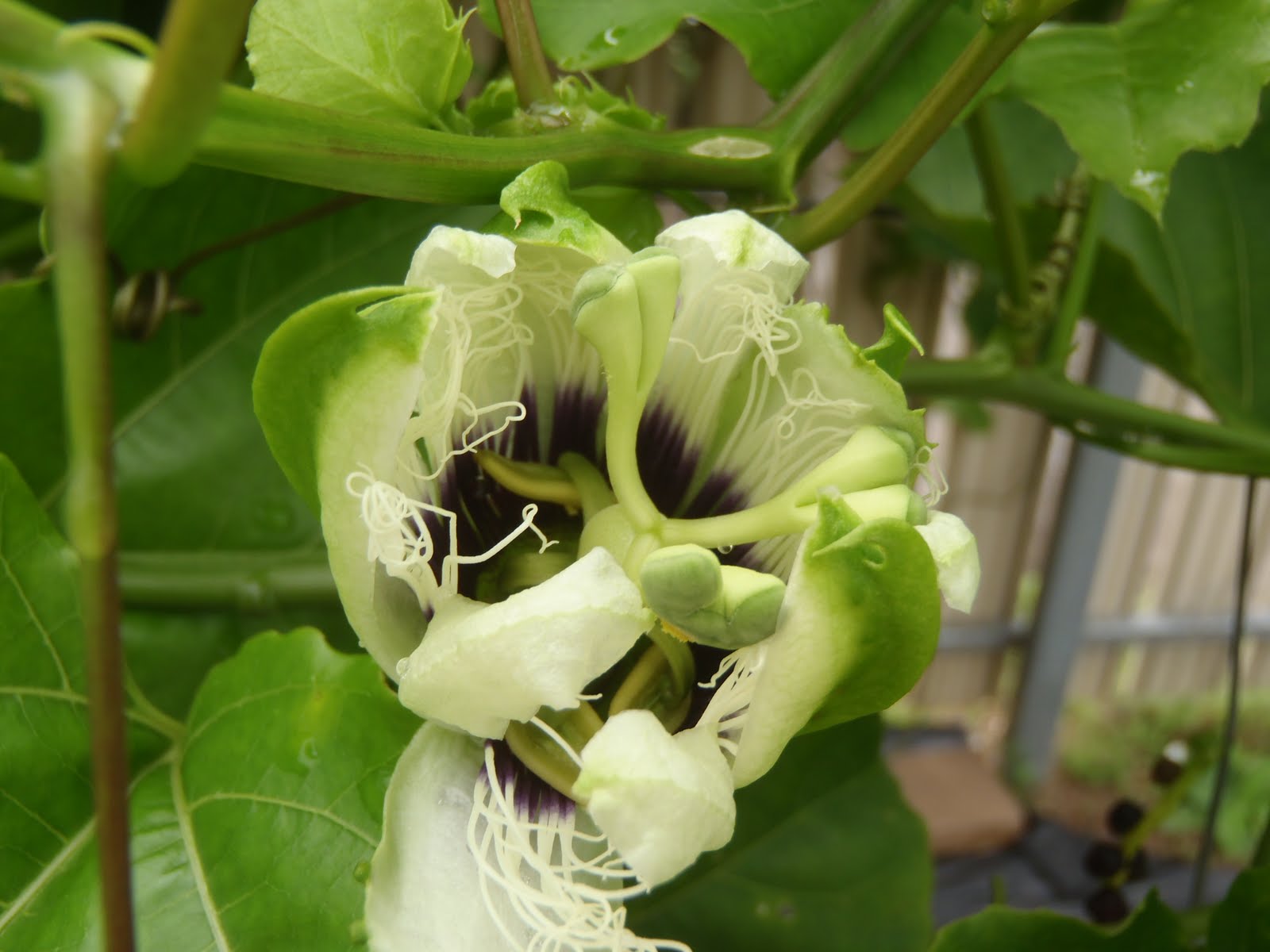
After waiting for what seems like A-GES.. our passionfruit vine has finally started to fruit! We didn't even notice the flowers - we were away for a week - and one day while checking the trellis I noticed a passionfruit almost the size of a tennis ball growing! Very exciting.

PASSIONFRUIT


Our big guava tree has also started to fruit. Just one at the bottomest branch at the moment. My problem now is deciding when to pick it. It's about the size of my fist now, however, it's not showing any signs of yellowing, the skin is still quite green.
PASSIONFRUIT FLOWER


Having never eaten guava before, my boyfriend asked what it tastes like. Guava has the texture of a pear, with a similarly thin skin. However it has many small seeds on the inside. Being a yellow guava, our fruit should grow larger than the local cherry guava. The fruit should also be quite fragrant.. and hopefully sweet.

YELLOW GUAVA

Friday, December 31, 2010

The Last Day

I thought I'd use the last day of the year to recap what 2010 has taught me...

1) Patience. Without it, I would have never discovered that worms WOULD grow in my worm farm. Guavas WILL grow on the Indian guava tree. And eggplants WILL develop when given the proper conditions - after 6 months of trial and error. (They are also extremely thirsty!)

2) Progression. The garden will continue to evolve, and remain in a state of flux. If something dies, it can be regrown. Or replaced. There is never an absolute, absolutely. I will continue to view it as a journey, and not as a final destination.


3) Natural does not always mean Non-harmful. Take the case of Neem Oil for example. Spraying it on capsicum plants caused fruit to rot. Leaves were also affected and appeared 'burnt'.

4) Perseverance. Like some of the plants in our garden, which have amazing abilities to persevere despite my mistreatment of them; I too, must learn to overcome setbacks and keep going.


Monday, December 20, 2010

Full Wet Season

It has been raining just about every day. The Wet is - without a doubt - finally here.

The buckets I have strategically placed about the garden are doing their job and I have plenty of rainwater to water the undercover plants with.

The passionfruit trellis has sufferred a setback; the vines are so vigorous they have collapsed the archway! Hmm... I'll have to motivate myself to do something about it soon, but have been busy entertaining a visitor from south.

A strange thing has been happening to the capsicum plants. The capsicums are growing and ripening, but when picked, they are soft and rotten. I have a feeling it may be the Neem oil I have been spraying to deter mealybugs, which are everywhere in the garden.

Although deemed organic and has been used for centuries, Neem oil is also harmful to certain plants. It seems to kill mealybugs ok, but may also be responsible for the rotten capsicums. So I have stopped spraying Neem and am now just waiting for a good capsicum. If I'm wrong about the Neem, then it must be a rotting disease - heaven forbid!

Oh, and the zucchini plant has well and truly died. It had blossom end rot. The rot starts at the flowering end of the fruit and spreads, rendering malformed lumps on the fruit and eventually the whole fruit decays - from the inside. The zucchinis looked almost normal except for the external lumpiness. I guess the rot spread throughout the rest of the plant and the leaves started wilting and eventually the whole plant died.

I REALLY hope this is not the same thing happening to the capsicums... The chillies are going strong though. Brilliant yellow colour. When will they turn red? It's been at least 6 weeks already...